Chef Kar Moon Cakes  2024 
              Tuesday September 17, 2024


▲ Richmond Centre


This year Mid-Autumn Festival falls on September 17, which is also my birthday; hence double happiness for me. I prepared two types of moon cakes to share with my friends. These two types of moon cakes are Traditional Cantonese Moon Cakes and Hong Kong Snow Skin Moon Cakes.


1. Traditional Cantonese Moon Cakes

Cantonese Moon Cakes originated from Guangzhou. The important characteristic of these moon cakes are that decorative design or pattern on the cake face are exquisite relief. The skin is thin and stuffing is rich; moisturizing and soft; bright and shiny; colour of skin is golden. Cantonese moon cakes can be classified by skin type as Syrup Skin, Puff Pastry and Snow Skin. Syrup Skin is the main type. Puff Pastry Moon Cake absorbs the way of preparation of western desserts; combines the characterists of Cantonese Moon Cake; produces mainly desserts with lotus seeds.

Moon Cake Stuffing: red beans, mung beans, purple yam, yellow sweet potatoes, red beans + purple yam, mung bean + yellow sweet potatoes, rock sugar/slab sugar, sunflower oil

Method:
1. Add water and steam cook the ingredients, add  rock sugar or slab sugar, drain out water
2. Use a spoon to smash ingredients, add oil, roll into balls

Syrup: 2 slab sugar, add 1 cup of water, use a pan to cook to reduce water to form syrup

Moon Cake Skin: Syrup Skin
Syrup Skin Ingredients: low gluten flour (bread flour) 175g, syrup 125g, corn oil 30g, lye water 1g

Method:
1. Mix all ingredients gently; do not knead to avoid forming gluten; flour dough is not sticky.
2. Use folding method: use hands to flatten flour dough, fold flour dough, repeat this process 8 time. Place the folded dough in fridge for 1 hour.
3. According to size of moon cake mold, cut a piece of dough and make thin disc, wrap Moon Cake Stuffing with disc, make into a ball. Use moon cake mold to press moon cake.
4. Place moon cake in oven at 350°F; bake to golden brown.


]


2.  Hong Kong Snow Skin Moon Cake

Snow Skin Moon Cake is a new style of moon cakes without baking originating from Hong Kong. It must be kept in low temperature. Its skin is made up of glutinous flour and flour. Stuffing, beside traditional lotus seeds, also has fruit puree, mashed beans, custard. No need to bake by oven, hence no need to brush cake face with oil.  
Preparation of Snow Skin Moon Cake originated from making of banana cake. Cake skin is white. It must be stored in fridge at 2-5 degree C.

Moon Cake Stuffing: red beans, mung beans, purple yam, yellow split peas, rock sugar or slab sugar, sunflower oil or other vegetable oil

Method:
1. Add water and steam cook the ingredients, add  rock sugar or slab sugar, drain out water
2. Use a spoon to smash ingredients, add oil, roll into balls

Moon cake skin: white original colour, green tea powder, blue butterfly pea flower

Ingredient
Glutinous rice flour 45g
Rice flour 40g
Wheat starch 20g
Milk 185g
Sugar  30g~50g
Sunflower oil or other vegetable oil 20g

Method:
1. Mix well milk, sugar and sunflower oil
2. Add glutinous rice flour, rice flour and wheat starch, mix well
3. Sieve batter once, rest for 30 minutes. If you want to add colour, add green tea powder or butterfly pea flowers now.
4. Steam batter for 20 minutes
5. Take out steamed batter. If butterfly pea flowers were added, remove them now.  Use chop sticks to stir until smooth, wait for it to cool down
6. Get ready for a pair of gloves and 2 rubber bands. Wearing them to avoid stickiness of dough. Rubber bands are used to tighten the gloves. It is OK without them.
7. Stir fry glutinous rice flour under low fire until golden brown. It is used to reduce stickiness.
8. Place snow skin dough in fridge for awhile.  It is easier to handle. According to moon cake mold, 18g for skin and 15g for stuffing. Wear the gloves, use your hand to press the skin flat, wrap the stuffing by pushing up.
9. Close the opening and dip some fried glutinous rice flour
10. Put some flour on the mold, place the moon cake dough in the mold, press and release the cake. Brush out the excessive flour on the moon cake
11. Seal the snow skin moon cake and store in the fridge for 4-5 hours. It can be store in the fridge for 2-3 days. To keep longer, it can be frozen in the freezer.
12. You can make snow skin moon cake with 2 colours


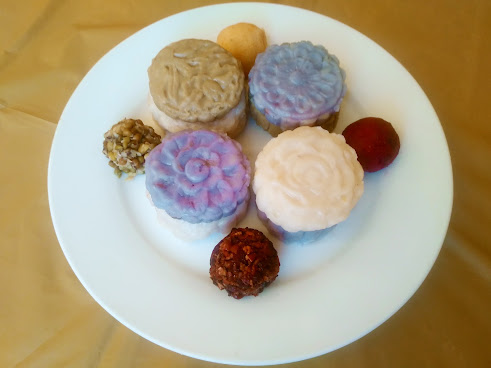
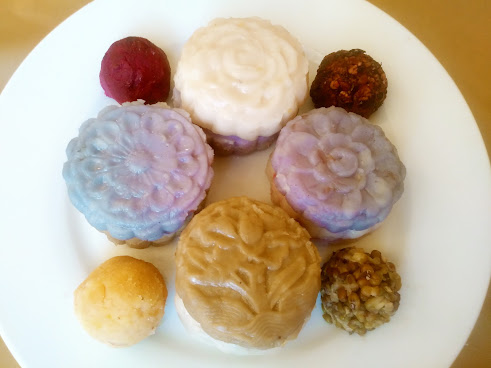


Moon Cake Mold


Welcome the Moon

Today September 16, I and my good friends gathered together to have coffee chats. I prepared a dozen of Cantonese moon cakes to share with them in order to welcome the moon.


Happy Mid-Autumn Festival!


Next,  Malaysian Noodle Delights Part 2 Of 3 
 
Publisher: Chef Kar Delight


Malaysian Noodle Delights Part 1 Of 3 
Thursday 2024/8/1


In Malaysia, noodles are popular staple, particularly in Malaysian Chinese cuisine, but used by other groups as well. Noodles such as bi hoon (米粉, Malay: bihun; rice vermicelli), kuay teow (粿條) or ho fun (河粉, flat rice noodles), mee (麵, Malay: mi; yellow noodles), mee suah (麵線, wheat vermicelli), yee meen (伊麵, golden wheat noodles), dongfen (冬粉, cellophane noodles), Lao Shu Fen (老鼠粉, silver needle noodles), and others provide an alternative source of carbohydrate to a serving of rice that accompanies every meal.

I am preparing  9 Malaysian noodle dishes for 3 episodes.

3 Episodes exploring:
Part 1:Asam Laksa; Char kway teow; Curry mee 
Part 2:Kerabu Beehoon; Laksa Lemak; Laksam
Part 3:Mee Bandung Muar; Mee Calong; Mee Siam

Part 1:Asam Laksa; Char kway teow; Curry mee 


▲ 1.  Asam Laksa

Asam Laksa is one of the most popular noodle dishes in Malaysia. It is synonymous to the island of Penang and is an all-time favorite there. This flavorful, spicy, and tangy rice noodle soup hits all the right notes and is a must-taste when you visit Malaysia.

Ingredients
. ¼ cup asam jawa / tamarind paste** (60g) + 1 cup (240ml) hot water
. 8 cups water (2 liters)
. 3 ikan kembung (chubb or yellowtail mackerel), gutted and scaled (about 20 oz/567g)
. 3 slices asam gelugor (dried tamarind skin)
. 12 to 15 stalks daun kesom (polygonum/Vietnamese coriander or mint)
. 2 tbsp sugar
. 2 tsp salt
. 2 packets fresh thick rice noodles (30 oz/950g) or 10 oz (283g) dried thick vermicelli***

Garnish
. 1 small cucumber (julienned)
. ½ pineapple (julienned)
. 1 red onion (thinly sliced)
. 2 red chilies (seeds removed and thinly sliced)
. 6 stalks mint leaves (stem removed)
. 2 bunga kantan / torch ginger, thinly sliced (optional)
. 4 tbsp hei ko (sweet shrimp paste)
. 1 lime (cut into wedges)

Spice Paste
. 7 dried chilies (seeded, soaked in warm water, and drained)
. 3 red chilies (seeded and cut into pieces)
. 10 shallots (peeled and cut into quarters)
. 2 stalks lemongrass (bottom third only, thinly sliced)
. 1 inch fresh turmeric (peeled) (30g)
. ¾ inch cube belacan (shrimp paste), toasted

Instructions

Spice Paste
1. Blend spice paste ingredients with ¼ cup (60ml) water. Transfer to a bowl.

Prepare the soup
1. Rinse asam jawa. Place in a bowl with 1 cup (240ml) hot water. Stir to dissolve some of the pulp then strain for the juice. Discard pulp.
2. Bring 8 cups (2 liters) water in a large pot to a boil. Add ikan kembung (mackerel), lower heat to medium low and simmer for 15 minutes. Remove fish when cooked. Strain liquid with a metal strainer. You should get about 6 cups (1.5 liters) fish stock.
3. Add tamarind juice, blended spice paste, asam gelugor, and daun kesum into pot with fish stock. Bring to a boil, lower heat, and allow it to simmer while you prepare the fish.
4. When fish is cool enough to handle, remove bones and flake the meat. Break into small pieces but keep some in bigger chunks.
5. Return flaked fish to the pot.
6. Season the soup with sugar and salt.

Cook the noodles
1. Cook noodles in boiling water for 1 to 2 minutes. Remove and strain.

Serve
1. Place some noodles in a bowl. Top with a little julienned cucumber, pineapple, onion, red chili, mint leaves, and bunga kantan (torch ginger). Pour gravy over the noodles.
2. Serve immediately with hei ko (shrimp paste) and lime wedges.


▲ 2.  Char kway teow

Char kway teow (sometimes also spelled as char kuey teow, 炒粿條) is a stir-fried rice noodle dish from Maritime Southeast Asia of southern Chinese origin. In Hokkien and Teochew, char means 'stir-fried' and kway teow refers to flat rice noodles. It is made from flat rice noodles ( 河粉) or kway teow (粿條) of approximately 1 cm or about 0.5 cm in width, stir-fried over very high heat with garlic, light and dark soy sauce, chili paste, whole prawns, shelled blood cockles, chopped Chinese chives, slices of Chinese sausage, and bean sprouts. Other common ingredients include fishcake and belachan.

Originally developed and catered to overseas-born Chinese labourers in the Southeast Asia region, the dish has achieved widespread popularity within the region from the late 20th century onwards, particularly in Malaysia and Singapore. The dish has also acquired a reputation of being unhealthy due to its high saturated fat content, as it is traditionally stir-fried in pork fat with crisp croutons of pork lard.

Ingredients
· 500 g / 1 lb fresh wide rice noodle 
· 2 tbsp lard , or vegetable oil 
· 2 tbsp vegetable oil , separated
· 10 small prawns/shrimp , shelled and deveined
· 2 garlic cloves , finely chopped
· 1 Chinese sausage / Lup Chong Sausage , sliced thinly on the diagonal 
· 5 cm / 2" piece of fried fish cake , sliced thinly 
· 20 stems garlic chives , cut into 4 pieces 
· 2 1/2 cups bean sprouts
· 2 eggs , whisked

Sauce:
· 5 tsp dark soy sauce 
· 4 tsp light soy
· 2 tsp oyster sauce 
· 4 tsp kecap manis / sweet soy sauce 
· Chili paste
· Belachan shrimp paste

Instructions

1. Mix Sauce together.

Noodles:
1. Do not attempt to pull noodles apart while cold and hard - they break.
2. Place whole packet in microwave, heat on high for 1 1/2 minutes - 2 minutes until warm and pliable, not hot, turning packet over as needed.
3. Handle carefully and measure out 500g/1 lb noodles into a heatproof bowl. Separate noodles stuck together.
4. If noodles become cold and brittle before cooking, cover with cling wrap and microwave for 30 seconds to make warm (not hot, just warm) to reduce breakage.
5. Cook.

Cooking:
1. Heat lard and 1 tbsp oil in a wok or very large heavy based skillet over high heat. Swirl around the wok.
2. When it starts smoking, add prawns. Cook for 30 seconds.
3. Add garlic, stir for 10 seconds.
4. Add noodles, then using both hands on the handle, toss 4 times until coated with oil (or gently fold using a spatula + wooden spoon).
5. Add Chinese sausage and fish cake, toss or gently fold 4 times.
6. Add bean sprouts and garlic chives, toss or gently fold 6 times.
7. Push everything to one side, add remaining 1 tbsp oil. Add egg and cook, moving it around until mostly set - about 1 minute. Use wooden spoon to chop it up roughly.
8. Pour Sauce over noodles, then toss to disperse Sauce through the noodles. Pause between tosses to give the noodles a chance to caramelise on the edges.
9. Serve immediately!


▲ 3.  Curry mee

Curry mee (mi kari; 咖喱麵) is a Maritime Southeast Asian spicy noodle soup garnished with various toppings. In Johor and Singapore, it is sometimes called curry laksa ( mi kari 咖喱喇沙; . 咖喱叻沙). Numerous variants of the dish, including preparations with a drier or thicker gravy, exist in both the countries of Malaysia and Singapore.
A typical preparation of Malaysian/Singaporean-style curry mee consists of thin yellow noodles or rice vermicelli immersed in a spiced broth enriched with coconut milk, accompanied with chilli or sambal relish. Potential toppings for curry mee include chicken, prawns, cuttlefish, cockles, boiled eggs, pieces of deep fried tofu puffs, fried foo chuk, green beans, bean sprouts and mint leaves.

Ingredients
· 2 tablespoons oil
· 1 onion (minced)
· 3 cloves garlic (minced)
· 1 tablespoon ginger (minced)
· 1 tablespoon lemongrass (minced)
· 1 tablespoon red curry paste
· ½ pound boneless skinless chicken thighs (thinly sliced)
· 3 tablespoons curry powder
· ½ teaspoon turmeric
· 13.5 ounces coconut milk (400 ml)
· 4 cups chicken stock (950 ml)
· 3 tablespoons fish sauce (optional for vegetarians)
· 1 teaspoon sugar
· 8 ounces egg noodles (225g)
· salt (to taste)
· 2 handfuls raw bean sprouts (washed and trimmed)
· Cilantro leaves (for garnish)
· 1 lime (cut into wedges)

Instructions

1. Heat the oil in a pot over medium high heat and add the onion, garlic, ginger, and lemongrass. Cook for about 6 minutes, until softened and fragrant. Stir in the red curry paste.
2. Turn the heat up to high and add the chicken. Stir-fry until the chicken turns opaque. Add the curry powder, turmeric, coconut milk, chicken stock, fish sauce, and sugar. Bring to a boil and simmer for 10 minutes.
3. Meanwhile, cook the noodles according to package directions. Divide into 3 soup bowls and set aside.
4. Taste the soup and season with salt to taste. Divide the soup among your bowls of noodles, and garnish with raw bean sprouts, cilantro, and a squeeze of lime.


Next Special, Chef Kar Moon Cakes 2024 

Following,  Malaysian Noodle Delights Part 2 Of 3 
 
Publisher: Chef Kar Delight


  Chef Kar Sweetheart Moon Cakes   2026                Friday September 25, 2026 ▲ Richmond Centre   Moon Cakes Represent My Heart This year...